
Industry Basics
For many potential coordinators, it's the spiritual mission that first attracts them to Apartment Life. But it's important to understand that our mission is tightly integrated with our business strategy. Take a moment a see how we are fully integrated as a business and a ministry - or as we like to say, "businestry."
What does it mean to be fully integrated?
It can be complex to integrate the demands of the business with the desire to have a spiritual impact.
Which is more important: our spiritual mission or the business outcomes?
Both are essential, because they were designed to work together. Our business outcomes allow us to operate with excellence, build trust, and sustain the work over time. Our spiritual mission reminds us that our work is ultimately about loving people because God first loved us.
As leaders, we are called to hold these together with intention. Excellence in our work reflects our commitment, while faithfulness to the mission shapes how and why we serve.
When these stay aligned, we not only meet expectations, we create meaningful impact. We build communities where people are cared for well and where spiritual fruit can grow. This is how we view the work God has given us, serving with both excellence and purpose.
Industry Key Players
Owners
The group who owns the property. Sometimes there are multiple groups who own, develop, or are part of the financial deal.
Management Company
The group who has been hired and is paid a fee by the owner to manage the property or group of properties (asset).
Property Manager
Works onsite at a property for the management company. Reports to a regional manager. May or may not have contact with the owner.
Regional Manager
Oversees the operations of a group of properties. Often the key decision maker in having Apartment Life services.
Asset Manager
Stewards the financials for the property, and works for the ownership company. Another key decision maker based on budget, cost/benefit.
Marketing Director
Go-to person for social media, training and access to property-specific platforms, event idea approvals, marketing material approvals, etc.
Our clients prioritize four key outcomes:
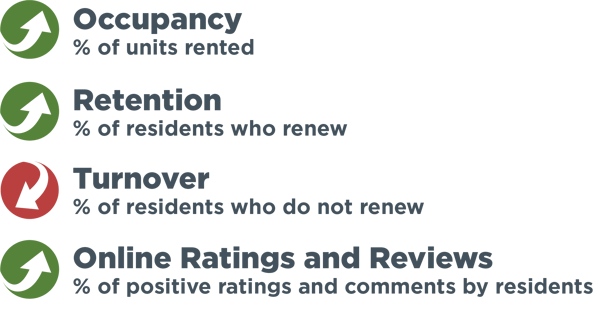
Resident turnover has a cost. Each unit that turns can mean lost revenue, marketing costs, and unit preparation expenses.
Once a unit is occupied, the focus shifts to retention. Residents who feel connected and cared for are more likely to renew and stay longer.
The multifamily industry does well with amenities and features, but often struggles with the relational side of apartment living. Residents want more than a place to live, they want to feel known, valued, and at home. Property teams often lack the time or capacity to provide that consistently.
Common Language
Now that you have learned a few key terms commonly used in the apartment industry, such as occupancy, retention, turnover, and online reputation management. Let’s build on that foundation with a few more important terms:
Fair Housing: This refers to the practices that comply with the Federal Fair Housing Act and its amendments. The purpose of the Fair Housing Act is to eliminate discrimination and ensure that all people are treated fairly, equally, and consistently in the sale, rental and financing of housing. Creating community where everyone is valued and invited in? That's us!
Apartment Community, not Complex: To anyone on the inside, it's an apartment community. And the people who will be directly responsible for building and enhancing the community should be the first to call it an apartment community. (Complex is like a swear-word to our clients.)
What YOU can do for Your Community
Online Reputation
Online reputation plays an important role in how a community is seen by current and prospective residents. While most multifamily communities already have strategies, partners, or platforms in place to manage reviews and ratings, we can still play an important supporting role. As we build genuine relationships with residents, we are often in a natural position to hear positive experiences and encourage residents to share them online. In this way, we help emphasize the good happening in the community, support client goals around ratings and reputation, and contribute to telling a better story about the place people call home.